
Junair · Downdraft
Junair CORE 3
Filter kit, alternatives, and current pricing for the CORE 3.
Fitment data is being verified. Our team is still cross-referencing manufacturer specs for the CORE 3. Confirm filter sizes with WERCS before ordering: request a fitment confirmation.
Junair model • CORE 3
Junair CORE 3 Filter Guide
Downdraft filtration without the flagship price tag still means three stages on a schedule. Media for the CORE 3, verified to your booth first.
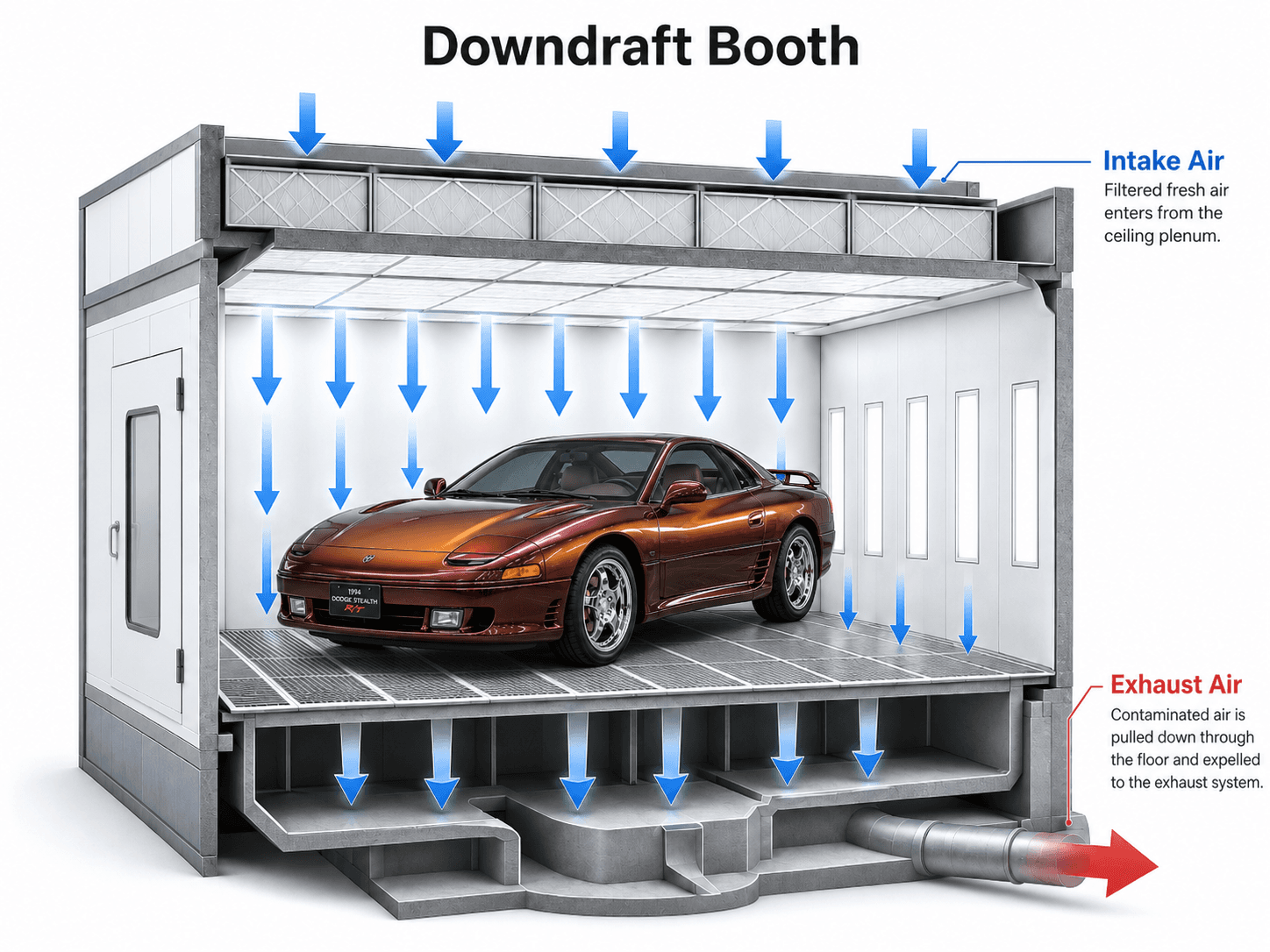
Choosing between a CORE 1 and a CORE 3 is choosing between air paths, not brands. Buyers step up to the CORE 3 to get downdraft airflow, the layout collision insurers and finish-critical customers keep asking about, while staying inside the CORE line's stripped-back cost structure. For filtration, that step up changes your consumables list completely: a full ceiling of diffusion media replaces the cross-flow's intake wall, and exhaust moves from a rear wall down to floor level. The purchase price was the simplified part. The filter program is full downdraft, and it deserves to be run like one.
Quick answer
Within Junair's simplified CORE line, the CORE 3 is the downdraft option: vertical airflow through ceiling diffusion media, out through arrestor at floor level, with pre-filter media where make-up air is conditioned. Its filter program mirrors what Junair's top-tier downdrafts run, because the airflow physics are identical even when the spec sheet is trimmed. In our catalog the CORE 3 is documented from the manufacturer's product range and awaits field verification, so filter dimensions are confirmed through a fitment check or quote before you commit to bulk quantities.
How CORE 3 shops choose filters
Ceiling stage. Downdraft finish quality is made or lost in the ceiling. The diffusion media has two jobs at once, fine filtration and even velocity distribution across the whole footprint, and it does both worse as it loads. On a value-tier downdraft there is a temptation to stretch ceiling changes to protect the budget; resist it, because the ceiling is the one stage the vehicle sits directly beneath.
Exhaust stage. At floor level the CORE 3 takes arrestor media, fiberglass or polyester by loading behavior, sized to the pit or grid arrangement of the specific installation. Floor media in a downdraft is out of sight in a way a cross-flow's exhaust wall never is, which is exactly why it gets forgotten until doors start slamming from pressure imbalance.
Sizing honestly. The dossier behind this page records the CORE 3 as a downdraft in Junair's current range and stops there: no panel counts, no dimensions, no verified slot map. So we do not publish guesses. First orders run through a fitment check (nameplate photo plus a couple of measurements), your booth's record is locked, and every reorder after that is automatic. If your installation includes a heated air make-up package, its pre-filter joins the same cadence.
Regulatory landscape
Regulators do not grade on booth price. A CORE 3 spraying automotive coatings falls under EPA 6H (NESHAP Subpart HHHHHH) with the same filtered-exhaust and recordkeeping obligations as any flagship booth, and OSHA 1910.94(c) holds the ventilation baseline for spray finishing operations either way. NFPA 33's concern is combustible overspray accumulation, which in a downdraft means the floor-level arrestor you cannot see from the shop floor. A standing change schedule with dated records satisfies all three frameworks at once, and costs less than one failed inspection.
Who runs the CORE 3
The CORE 3 attracts shops graduating into downdraft. Independent collision shops replacing an aging cross-flow because DRP programs and customer expectations pushed them toward downdraft finish quality. Growing operations adding a second booth that want Junair equipment throughout without duplicating flagship spend. And rural or small-market body shops where the CORE 3 is the main production booth and the owner wants its three filter stages arriving on schedule rather than managed from memory between jobs.
CORE 3 filter FAQs
Does the CORE 3 use the same filters as the 7 Series or 9 Series?
Same stage types, because all three are Junair downdrafts: ceiling diffusion media, floor exhaust arrestor, pre-filter for conditioned make-up air. Dimensions are another matter. None of these models has field-verified slot data in our catalog yet, so each booth is confirmed individually, and CORE-tier ceilings should never be ordered off a 7 or 9 Series record.
Is a cheaper booth fine with cheaper filter media?
The booth tier does not lower the bar, because the air path is the same as a premium downdraft. Where you can economize is cycle strategy, like running polyester exhaust arrestor that holds more overspray between changes, not by dropping to media that lets fines through the ceiling onto wet paint.
What measurements do you need for the fitment check?
Three things cover it: the booth nameplate (model and serial), the face dimensions of one ceiling panel or the ceiling grid layout, and the size of one exhaust pad or the pit opening. Photos with a tape measure in frame work fine. That single exchange upgrades your record permanently.
My CORE 3 is drying slower and doors feel pressurized. Related?
Probably, and filters are the cheap hypothesis to test first. Loaded floor arrestor chokes exhaust flow, which raises booth pressure and slows air exchange, and both symptoms follow. Change the exhaust media, verify the manometer reading, and escalate to a service call only if fresh media does not restore balance.
Can I put off the ceiling change if the exhaust is fresh?
For a while, but watch what you are trading. A loading ceiling filters air unevenly before it reaches the vehicle, and the first symptom is usually nibs in horizontal surfaces, which cost polishing time per job. When buffing hours creep up, the ceiling change was already due.
Sources
Primary references cited on this page.
- Junair CORE 3 manufacturer product pagehttps://www.junair-spraybooths.co.uk/products/spray-booths/
- NFPA 33, Standard for Spray Application Using Flammable or Combustible Materialshttps://www.nfpa.org/codes-and-standards/nfpa-33-standard-development/33
- EPA 40 CFR Part 63 Subpart HHHHHH (NESHAP 6H)https://www.epa.gov/stationary-sources-air-pollution/national-emissions-standards-paint-stripping-and-miscellaneous