
Junair · Crossdraft
Junair CORE 1
Filter kit, alternatives, and current pricing for the CORE 1.
Fitment data is being verified. Our team is still cross-referencing manufacturer specs for the CORE 1. Confirm filter sizes with WERCS before ordering: request a fitment confirmation.
Junair model • CORE 1
Junair CORE 1 Filter Program
Two filter stages, changed on time, are the whole game in a cross-flow. Media for the CORE 1, sized to your booth after a quick fitment check.
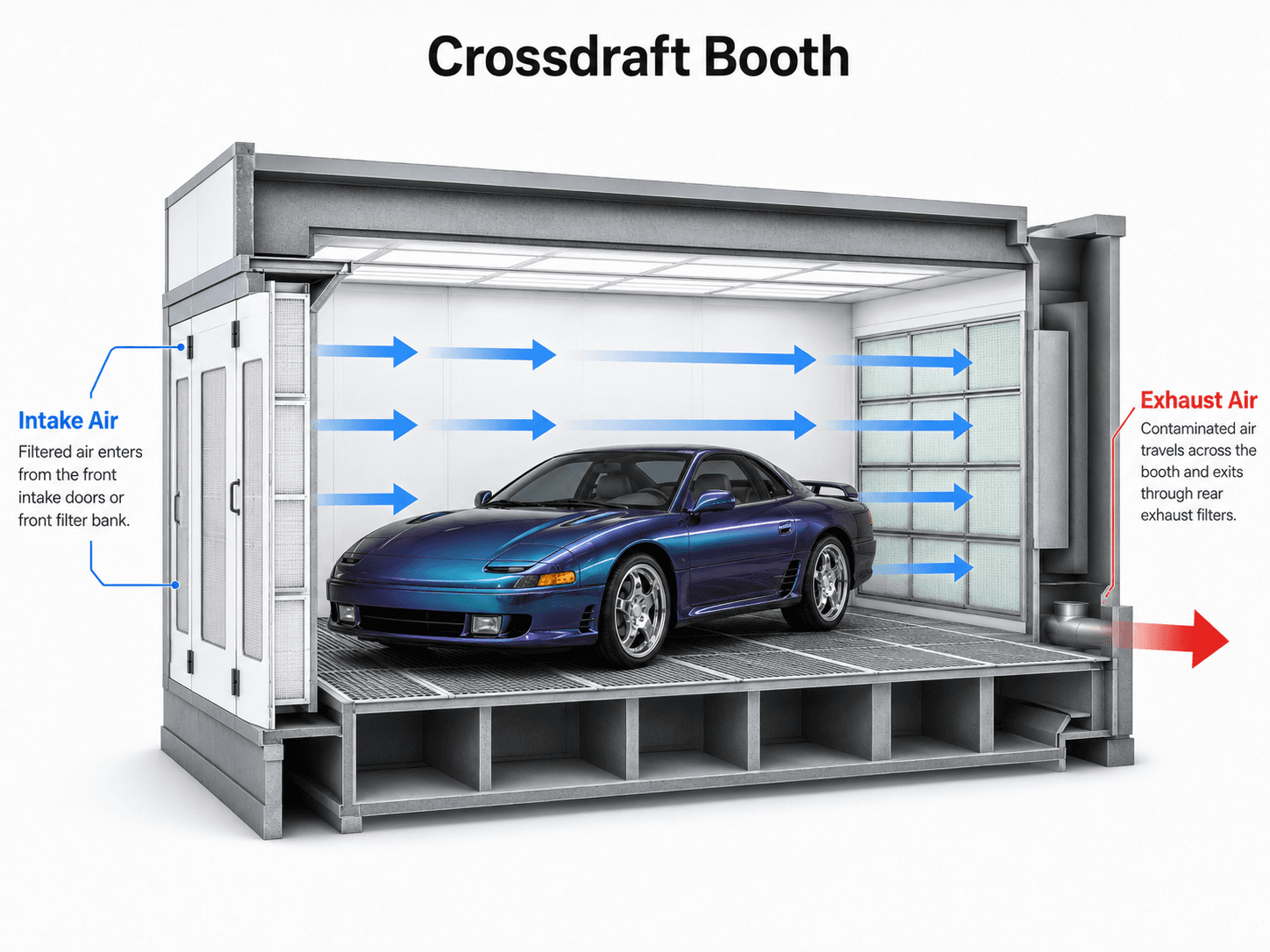
The CORE line is Junair stripping its booth engineering down to a straightforward spec at a lower entry cost, and the CORE 1 is that idea in cross-flow form. Cross-flow booths cost less to buy and less to feed: no full-ceiling media set, no exhaust pit, just filtration at each end of a horizontal air path. The trade is that air passes along the vehicle rather than down over it, so anything the intake media misses gets a longer ride across your wet paint. In a cross-flow, more than any other layout, filter freshness is the finish quality lever, which is good news, because it is also the cheapest lever you have.
Quick answer
Filter spend on a Junair CORE 1 is about as simple as booth economics get: intake panel media where air enters, arrestor media at the exhaust wall where overspray leaves, changed on a schedule you actually keep. The CORE 1 is the cross-flow model in Junair's CORE line, the simplified-specification tier below the 7 and 9 Series downdrafts. Air travels horizontally from the intake face over the vehicle to the exhaust end. The model is catalog-documented and pending field verification in our system, so intake and exhaust dimensions are confirmed with a fitment check before bulk orders ship.
How CORE 1 shops choose filters
Intake side. The intake face is your only barrier between shop air and wet paint, with no ceiling stage behind it to catch what slips through. That argues for treating intake panels as the premium position in the budget: a tacky-faced synthetic panel media, seated with no bypass gaps around the frame, changed before it blinds. Gaps matter as much as media grade; a quarter-inch of daylight around a panel is an unfiltered jet aimed at your work.
Exhaust side. The exhaust wall runs arrestor media, fiberglass pad or roll as the default, polyester where loading runs heavy. When exhaust arrestor loads up in a cross-flow, face velocity falls and overspray starts drifting back into the booth instead of leaving it. If you smell solvent lingering or see fog mid-booth, the exhaust wall is where to look first.
Cycle math. A sensible CORE 1 pattern is several exhaust changes for each intake refresh, tuned by spray volume. Because the dossier for this model does not document panel counts or dimensions, our first shipment follows a fitment check: nameplate, one intake panel measurement, one exhaust pad measurement. From then on, the sizes are on file.
Regulatory landscape
A simplified booth carries the full-size rulebook. EPA 6H (NESHAP Subpart HHHHHH) applies to automotive refinish spraying in a CORE 1 exactly as it does in a flagship downdraft: filtered exhaust, manufacturer-guided maintenance, records kept. OSHA 1910.94(c) sets ventilation requirements for spray finishing areas, and cross-flow booths that skip exhaust changes are the classic way small shops fall below the line. NFPA 33 rounds it out: overspray-loaded media at the exhaust wall is combustible accumulation, so the change log you keep for the EPA is the same one the fire marshal wants to see.
Who runs the CORE 1
CORE 1 buyers cluster at the practical end of the market. Independent one-booth and two-bay collision shops where the booth budget had to leave room for a frame rack, and the filter program needs to be cheap and repeatable. Fleet and light-commercial refinishers spraying utility finishes where cross-flow throughput beats downdraft polish. And startup or second-location shops that bought the simplified Junair spec to get a name-brand booth under a tight capital plan, and want consumables handled by subscription so nobody has to remember.
CORE 1 filter FAQs
What filters does the Junair CORE 1 use?
Two stages: intake panel media at the air entry face and arrestor media at the exhaust wall, consistent with its cross-flow layout. Exact dimensions for this model are pending field verification in our catalog, so we confirm sizes with a fitment check before shipping in quantity.
Is a cross-flow booth's filtration worse than a downdraft's?
Not worse, different. A downdraft adds a ceiling stage and pulls contaminants away from the surface vertically; a cross-flow relies entirely on intake media quality and fresh exhaust arrestor. Run good intake panels on a disciplined cycle and a CORE 1 produces clean work; run them long and the layout gives you no second chance.
How do I know when the exhaust arrestor is done?
Watch pressure drop if you have a gauge, and watch behavior if you do not: overspray fog persisting after the gun stops, solvent smell hanging in the booth, or a visible mat of dried overspray on the media face. Any of those means the pad is past due, not almost due.
Can I buy CORE 1 filters without knowing my panel sizes?
Yes, that is what the fitment check is for. Send the booth nameplate and quick measurements of one intake panel and one exhaust pad, or request a quote and we will walk you through it. After the first confirmed order, reorders need nothing.
Does the CORE 1 have an air make-up unit filter too?
Configuration varies at this tier, and the dossier for this model does not document an AMU package, so we do not assume one. If your installation includes heated make-up air, tell us during the fitment check and the pre-filter media joins the same delivery cadence.
Sources
Primary references cited on this page.
- Junair CORE 1 manufacturer product pagehttps://www.junair-spraybooths.co.uk/products/spray-booths/
- OSHA 29 CFR 1910.94(c), Ventilation: spray finishing operationshttps://www.osha.gov/laws-regs/regulations/standardnumber/1910/1910.94
- EPA 40 CFR Part 63 Subpart HHHHHH (NESHAP 6H)https://www.epa.gov/stationary-sources-air-pollution/national-emissions-standards-paint-stripping-and-miscellaneous