
Saima · Downdraft
Saima THESIS
Filter kit, alternatives, and current pricing for the THESIS.
Fitment data is being verified. Our team is still cross-referencing manufacturer specs for the THESIS. Confirm filter sizes with WERCS before ordering: request a fitment confirmation.
Saima model • THESIS
Saima Thesis: Filter Supply for an Orphaned Downdraft
A booth from Saima's large-vehicle series, still earning its floor space. The filters never went out of production; only the part numbers did.
There is a moment every owner of a discontinued European booth hits: the finish is still excellent, the fans still pull, and the supplier who used to send filters has stopped answering. The Thesis generates that moment regularly. Saima earned a real North American installed base before the OEM channel receded, and the engineering lineage carries on in the US under the Accudraft name, but a Thesis owner today is on their own for consumables unless someone re-documents the booth. The practical point: nothing inside a Thesis requires Saima to still be selling it. Ceiling diffusion media and exhaust arrestor are living product categories, and your booth just needs its sizes established once.
Quick answer
The Saima Thesis is a downdraft spray booth that Saima Meccanica's installation catalog places in its large-vehicle series. Like every downdraft, it consumes two main media positions: ceiling diffusion filters in the intake plenum and paint arrestor media in the under-floor exhaust. Saima's published record for the Thesis does not include slot counts or dimensions, and the model carries our verification flag for that reason. Getting filters is a one-time exercise: measure or photograph the ceiling grid and exhaust pit, the WERCS service team confirms sizes against distributor and manufacturer catalogs, and from then on the Thesis reorders like any current-production booth.
How THESIS shops choose filters
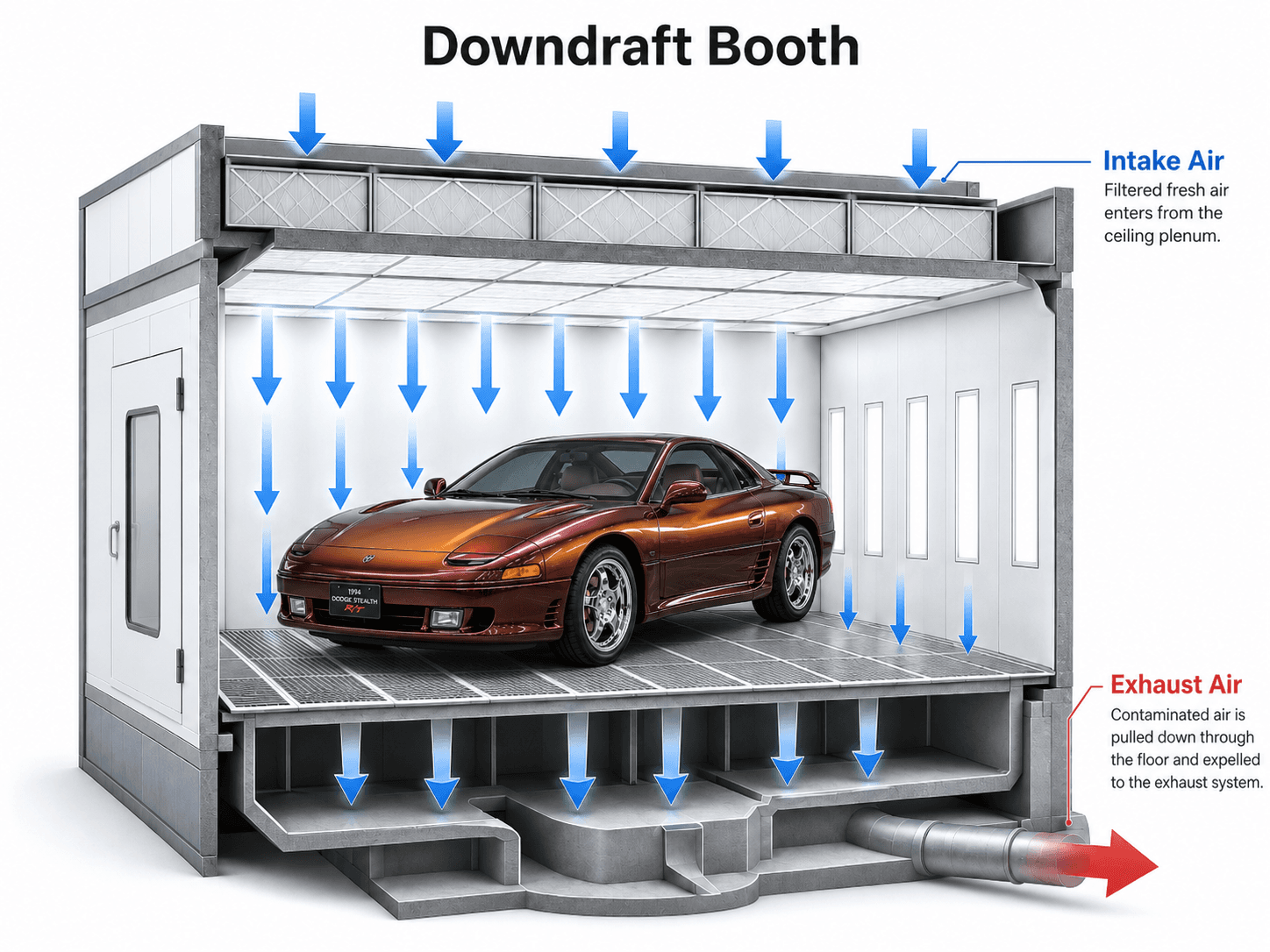
Intake side. The Thesis feeds air down through a ceiling plenum lined with diffusion media, the position that decides whether a large panel lays down clean or collects debris. In a booth sized for bigger vehicles the ceiling bank is long, so panel count matters as much as panel size when pricing a changeout. Count the grid openings, measure one panel and its frame opening, and the intake fitment is settled; we hold it on file.
Exhaust side. Overspray leaves through arrestor media below the floor grating. Fiberglass pad and roll stock dominate this position on legacy European downdrafts because they cut to the pit layout without OEM framing, and roll goods are usually the economical answer for a longer booth. This is also the position to inspect first when buying a used Thesis: pits hide neglect, and a booth that sat idle often has media in it that should have left years ago.
Cycle math. Exhaust drives the schedule; it takes the whole overspray load while ceiling media only cleans incoming air. Change exhaust on pressure rise if the booth has a working gauge, or on visible loading and pressure drift if it does not. Ceiling media runs a longer interval but has a hard stop: the first fiber it sheds into a wet clearcoat cost more than the panel set.
Regulatory landscape
An orphaned booth has no compliance exemption. EPA NESHAP 6H requires shops spraying target-HAP coatings to do it inside a filtered enclosure with maintained, documented filters; inspectors do not care whether the manufacturer still trades in the US, only whether the media is intact and the changes recorded. OSHA 29 CFR 1910.94(c) holds the booth to real ventilation performance, which degrades as fast as the exhaust media blinds. NFPA 33 treats caught overspray as combustible loading, so a Thesis pit full of aged arrestor is a fire finding waiting to be written. A standing filter schedule with dated deliveries answers all three.
Who runs the THESIS
The Thesis installed base skews toward work that needs its size. Truck and RV refinishers who bought large-format downdraft capability secondhand and run it as the main production booth. Collision shops in buildings that came with the booth, where the Thesis handles duallies, vans, and the box truck the newer booth cannot swallow. And fleet operations that repaint their own equipment seasonally, park the booth between campaigns, and need media on hand when the season starts.
THESIS filter FAQs
Saima does not answer US parts inquiries. Can I still keep a Thesis running?
Yes, indefinitely, as far as filters are concerned. Both media positions on the Thesis use filter categories in continuous production from multiple manufacturers. What died with the OEM channel was the part-number lookup, and a one-time fitment check replaces it.
Why does this page say fitment data is being verified?
Because the honest answer is that Saima's catalog documents the Thesis as a model but not its filter dimensions, and we do not publish sizes we cannot source. Your booth exits that status the day we verify it from your measurements or photos.
What should I check before buying a used Saima Thesis?
Lift the floor grates and look at the exhaust media and pit condition; that tells you how the booth was maintained better than anything the seller says. Check the ceiling media for sagging or shedding, and judge airflow only against fresh filters.
Is the Thesis the same booth as the Saima Grandi Mezzi?
They are separate entries in Saima's catalog; both sit in the large-vehicle territory, with Grandi Mezzi covering the heavy-vehicle and aircraft end of the range. If your nameplate is illegible, photos of the cabin and plenum arrangement let us identify which record your booth belongs to before we verify sizes.
How fast can I get filters once my sizes are confirmed?
Once the fitment is on file, Thesis orders ship like any stock media order, since the underlying pads and rolls are standard catalog items rather than OEM specials. The only slow step is the first one.
Sources
Primary references cited on this page.
- Saima THESIS manufacturer product pagehttps://www.saimameccanica.com/en/our-installations/
- EPA 40 CFR Part 63 Subpart HHHHHH (NESHAP 6H)https://www.epa.gov/stationary-sources-air-pollution/national-emissions-standards-paint-stripping-and-miscellaneous
- OSHA 29 CFR 1910.94(c), Ventilation: spray finishing operationshttps://www.osha.gov/laws-regs/regulations/standardnumber/1910/1910.94
Related on BoothFilterPro
- All Saima models
Brand hub
- 2000 Maxidraft Option 1
Sibling Saima model
- 2000 Maxidraft Option 3
Sibling Saima model
- Saima Accudraft Paint Booth Option 1
Sibling Saima model
- 2000 Maxidraft Option 2
Sibling Saima model
- PREPKLEEN
Sibling Saima model