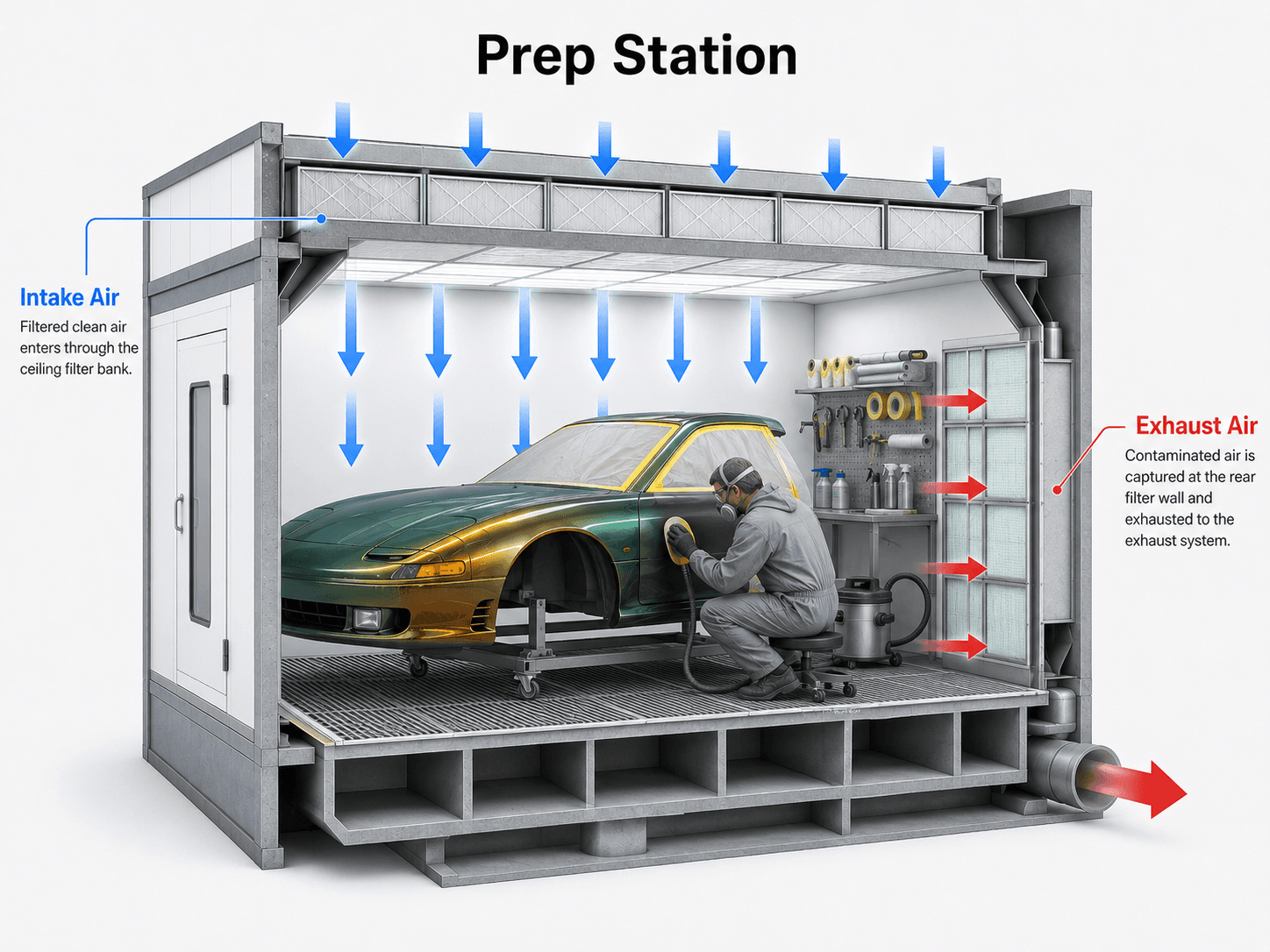

Saima · Prep station
Saima PREPKLEEN
Filter kit, alternatives, and current pricing for the PREPKLEEN.
Fitment data is being verified. Our team is still cross-referencing manufacturer specs for the PREPKLEEN. Confirm filter sizes with WERCS before ordering: request a fitment confirmation.
Saima model • PREPKLEEN
Saima PrepKleen: Filters for the Prep Station That Works Hardest
Prep decks eat filters faster than paint booths and get serviced less. We keep the PrepKleen's media stocked and sized.
In most shops, the prep station is the dirtiest air in the building. Sanding throws dry dust, primer throws high-solids overspray, and both hit the filters immediately, without the settling distance a full-size booth gives its media. Saima built the PrepKleen to contain that work, alongside its Kleen Box and Spraykleen siblings, and stations from that era still stand in shops across North America; the Saima lineage continues under the Accudraft name in the US. The failure mode we see is not broken equipment. It is a prep deck running months past its filter change because nobody knew where to buy media after the original supplier faded out.
Quick answer
The Saima PrepKleen is the prep-station entry in Saima Meccanica's Kleen product family, built for the sanding, masking, and priming work that happens before a vehicle reaches the spray booth. Prep stations run filtered exhaust to capture sanding dust and primer overspray at the work area, and the filter media in that exhaust path is the station's principal consumable, with intake or pre-filter media where the design draws conditioned air. Saima's catalog record does not document the PrepKleen's slot dimensions, so we verify each station from a photo or measurement before shipping a kit, then hold the size on file for reorders.
How PREPKLEEN shops choose filters
Exhaust is everything here. A prep station's job is capture at the source, and its exhaust filter is the capture. Sanding dust is fine, dry, and fast-loading; primer overspray is sticky and heavy. Together they load exhaust media faster than a paint booth's arrestor sees from basecoat and clear. Whatever arrestor format your PrepKleen's exhaust path holds (pad, roll, or pleated media), it should be the shortest-interval consumable in your shop, and skipping it costs capture velocity exactly where OSHA measures it.
Intake and recirculation. Prep station designs vary in how they supply air: some draw shop air through overhead or wall media, others condition make-up air through a pre-filter stage. Saima's published record does not settle which arrangement your station has, so the fitment check covers the supply side too: photograph every filtered opening, not just the obvious exhaust, so nothing runs bare.
Cycle math. Run exhaust media on a short, fixed interval tied to workload (jobs prepped, not weeks elapsed), because dust loading is invisible until airflow drops. When sanding dust hangs in the air instead of pulling away from the panel, the change is already overdue. Intake or pre-filter media runs a longer multiple; change it on visible dirt bleed, then tune.
Regulatory landscape
OSHA 29 CFR 1910.94(c) is the standard with teeth for prep work: it requires ventilation that carries contaminated air away from the operator's breathing zone, and a dust-blinded exhaust filter defeats that directly, pushing technicians onto respirator protection alone. EPA NESHAP 6H reaches prep stations when target-HAP coatings, primers included, are sprayed there; the rule expects a filtered enclosure and documented filter maintenance. NFPA 33 rounds it out: captured sanding dust and primer overspray is combustible accumulation, so used media handling and a real change schedule are fire-code hygiene, not just air-quality hygiene.
Who runs the PREPKLEEN
Three shops own PrepKleens. High-volume collision shops using the station to keep sanding dust out of the spray booth's airstream, where the prep deck runs all day and its filters take more abuse than the booth's. Two-bay independents where the PrepKleen doubles as the primer station, mixing dry dust and wet overspray in the same media, the hardest duty a filter sees. And shops that inherited the station with the building and run it as a glorified work bay, fans on, filters ancient, one fitment check away from working as designed.
PREPKLEEN filter FAQs
What filters does a Saima PrepKleen take?
Exhaust arrestor media in the station's extraction path, plus intake or pre-filter media where the design draws supply air. Saima's catalog does not publish the slot dimensions, so we confirm your station's sizes once, from photos or a measurement, and keep them on file.
How often should prep station filters be changed compared to booth filters?
More often. Sanding dust and primer overspray load media faster than topcoat overspray, and prep filters sit closer to the work. Tie the exhaust interval to jobs prepped rather than calendar weeks, and treat hanging dust at the deck as a past-due signal.
Can I run my spray booth's exhaust pads in the PrepKleen?
Often yes on media family, rarely on size. Arrestor media types overlap between booths and prep stations, but frame formats and dimensions differ, and an undersized pad stuffed into a prep grid leaks dust around its edges. Verify the station's own sizes; do not improvise from booth stock.
Do I have to spray primer inside the prep station?
If the primer contains EPA 6H target HAPs, spraying belongs in a filtered enclosure with maintained filters, and a properly filtered PrepKleen qualifies for that role. With dead or missing filters it does not, whatever the nameplate says. Fresh media is what makes the station a compliant place to prime.
My PrepKleen pulls weakly even with new filters. What next?
Check the whole air path: fan belt and rotation, duct obstructions, and any pre-filter stage hiding upstream of the fan that did not get changed with the mains. If the path is clear and pull is still weak, that is mechanical service territory, not a media problem.
Sources
Primary references cited on this page.
- Saima PREPKLEEN manufacturer product pagehttps://www.saimameccanica.com/en/our-installations/
- OSHA 29 CFR 1910.94(c), Ventilation: spray finishing operationshttps://www.osha.gov/laws-regs/regulations/standardnumber/1910/1910.94
- EPA 40 CFR Part 63 Subpart HHHHHH (NESHAP 6H)https://www.epa.gov/stationary-sources-air-pollution/national-emissions-standards-paint-stripping-and-miscellaneous
Related on BoothFilterPro
- All Saima models
Brand hub
- 2000 Maxidraft Option 1
Sibling Saima model
- 2000 Maxidraft Option 3
Sibling Saima model
- Saima Accudraft Paint Booth Option 1
Sibling Saima model
- 2000 Maxidraft Option 2
Sibling Saima model
- GRANDI MEZZI
Sibling Saima model