Rohner · Crossdraft
Rohner Modified Crossdraft
Filter kit, alternatives, and current pricing for the Modified Crossdraft.
Rohner model • Modified Crossdraft
Rohner Modified Crossdraft Filter Fitments
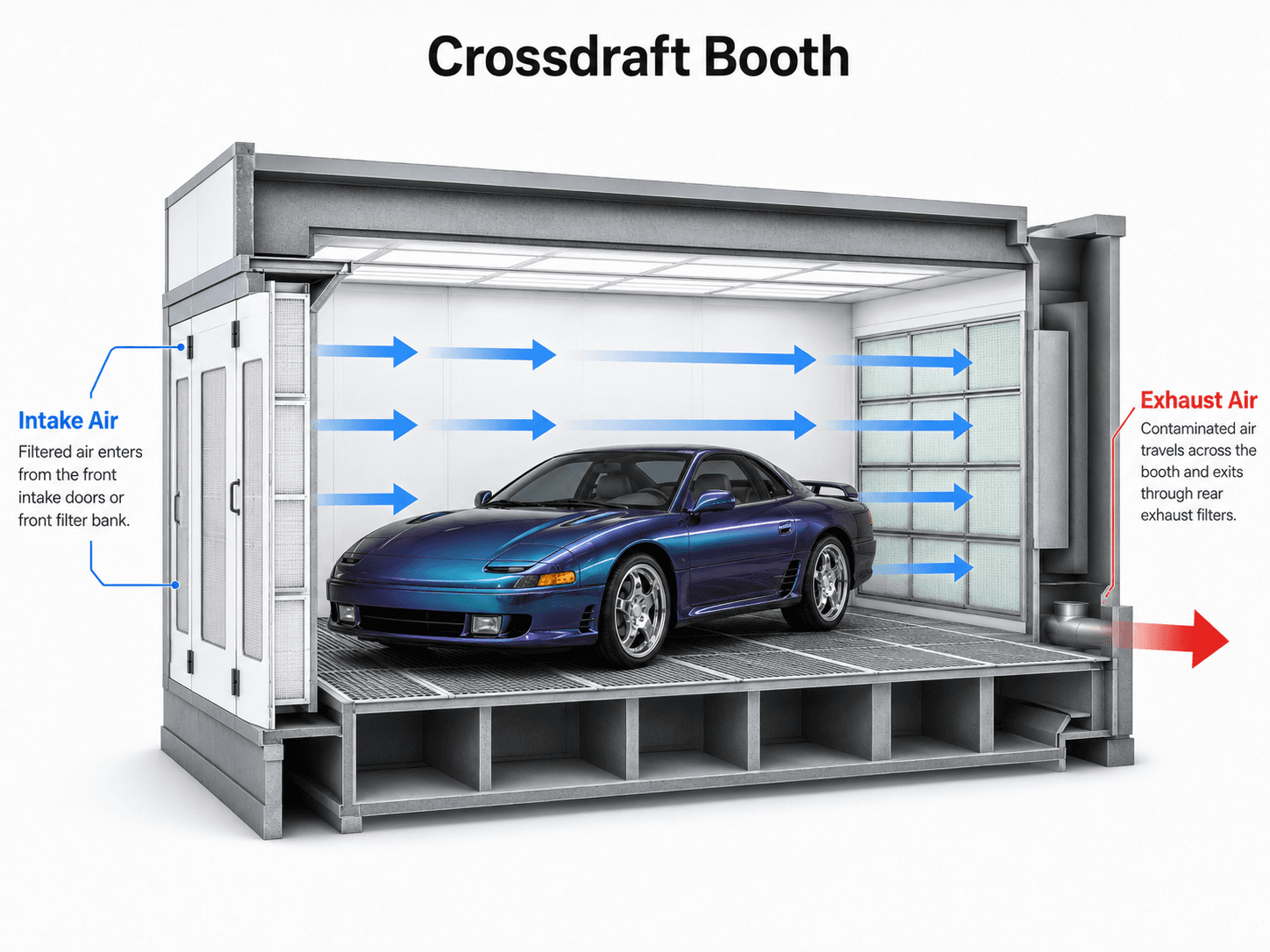
Crossdraft survives in industrial finishing because the economics are honest: fewer filter surfaces, simpler construction, no exhaust pit, and airflow that is entirely adequate for work where a downdraft finish standard is not the requirement. The "modified" in Rohner's design refers to how intake air is introduced and distributed relative to a plain open-face crossdraft, giving better control over how air enters the chamber. The physics of horizontal flow still hold: intake air cleanliness and exhaust bank condition are the two levers you actually control.
Quick answer
Filter cost per square foot of booth is the argument for the Rohner Modified Crossdraft. Air travels horizontally, entering through filtered intake at one end of the chamber and exhausting through an arrestor wall at the other, so the booth needs intake media and an exhaust bank rather than a full filtered ceiling and floor. Rohner offers it as a 16-variant industrial family from 14' x 10' x 26' up to 20' x 16' x 60', spanning roughly 14,000 to 32,000 CFM on 5 to 10 HP fans; the representative MCD-16-16-40 moves 25,600 CFM through a 16' x 16' x 40' chamber. Fitment on this family is catalog-documented and in verification, so run a fitment check to pin panel counts for your variant before bulk ordering.
How Modified Crossdraft shops choose filters
Intake side. Horizontal airflow gives dirt the longest possible ride across your work, so intake filtration quality matters more here than in any downdraft. Every particle that gets through the intake media travels the full chamber length at part height before the exhaust wall takes it. Keep the intake stage fresh and seated; it is the cheap end of the finish-quality equation.
Exhaust side. The exhaust wall carries arrestor media sized to the chamber cross-section. It takes the entire overspray load of the booth. As it loads, static pressure climbs and face velocity at the intake end falls off, which operators feel as overspray hanging around the part instead of clearing toward the wall. Change on differential pressure.
Cycle math. Expect the exhaust wall to cycle several times for every intake change, since exhaust media meets concentrated overspray while intake media only meets plant air. With 16 variants from 26 to 60 feet deep, panel quantities differ booth to booth; our record comes from Rohner's published spec table, so we confirm your MCD designation on the first quote.
Regulatory landscape
For liquid spray work, NESHAP 6H applies when target metal HAP coatings are sprayed: the booth must be fitted and operated with exhaust filtration, and your filter maintenance records are the evidence an inspector asks for first. OSHA 29 CFR 1910.94(c) sets ventilation expectations for spray finishing, including maintained airflow through the booth. NFPA 33 treats overspray-loaded media as combustible residue; on a booth whose exhaust wall concentrates all of it in one plane, scheduled changes and prompt disposal are the fire-code baseline, not extra credit.
Who runs the Modified Crossdraft
The Modified Crossdraft population skews industrial. Trailer, tank, and truck-body builders painting long workpieces that the 40 to 60 foot variants fit, where finish requirements are functional rather than automotive-grade. General fabricators and steel service shops coating structural work, railings, and weldments in production batches. And equipment refurbishers, from ag to construction, who need full-size enclosure and code-compliant extraction more than they need a showroom finish.
Modified Crossdraft filter FAQs
What makes a crossdraft "modified" and does it change my filters?
The modification is in how intake air is brought into the chamber and distributed compared with a plain open-face crossdraft, improving control of the incoming airstream. The consumable program stays the same in kind: intake filtration at the entry end, arrestor media across the exhaust wall.
My finish quality dropped but my exhaust filters look fine. What should I check?
Check the intake stage first. In horizontal flow, contamination that passes the intake media travels the length of the part, so aging intake filters or gaps around their frames show up as dirt-in-paint long before the exhaust wall is the problem. Reseat panels, look for bypass paths at the corners, and check how old the intake media actually is.
How many exhaust panels does my Rohner Modified Crossdraft take?
It depends on which of the 16 variants you have; the family runs from 14' x 10' x 26' to 20' x 16' x 60' and the exhaust wall is sized to the chamber cross-section. Our data for this family is from Rohner's specification table and is still being field-verified, so send your MCD designation or wall measurements through a fitment check and we will confirm the count.
Can I run the exhaust wall longer to save on media?
You can, and it costs you more than it saves. A loading wall raises static pressure, drops airflow, and lets overspray linger in the chamber, which slows flash-off, fogs adjacent surfaces, and works the fan against rising resistance. Media is the cheapest component in that chain.
Is a crossdraft booth still compliant for 6H work?
Yes, when it is operated correctly. 6H requires spray application inside a booth fitted with exhaust filtration and maintained per the manufacturer's guidance; it does not mandate downdraft airflow. The compliance burden lands on demonstrable filter maintenance, so keep the change log with dates and media types alongside your painter certifications.
Sources
Primary references cited on this page.
- Rohner Modified Crossdraft manufacturer product pagehttps://www.rohnerspraybooths.com/paint-booths/modified-crossdraft/
- EPA 40 CFR Part 63 Subpart HHHHHH (NESHAP 6H)https://www.epa.gov/stationary-sources-air-pollution/national-emissions-standards-paint-stripping-and-miscellaneous
- NFPA 33, Standard for Spray Application Using Flammable or Combustible Materialshttps://www.nfpa.org/codes-and-standards/nfpa-33-standard-development/33
Related on BoothFilterPro
- All Rohner models
Brand hub
- Rohner Side Downdraft
Sibling Rohner model
- Rohner Open Front Booth
Sibling Rohner model
- Rohner Custom Crossdraft
Sibling Rohner model
- Rohner Custom Downdraft
Sibling Rohner model
- Paint Mixing Room
Sibling Rohner model