Rohner · Powder booth
Rohner In-line Process Recovery Powder Booth
Filter kit, alternatives, and current pricing for the In-line Process Recovery Powder Booth.
Rohner model • In-line Process Recovery Powder Booth
Rohner In-line Process Recovery Powder Booth Filter Fitments
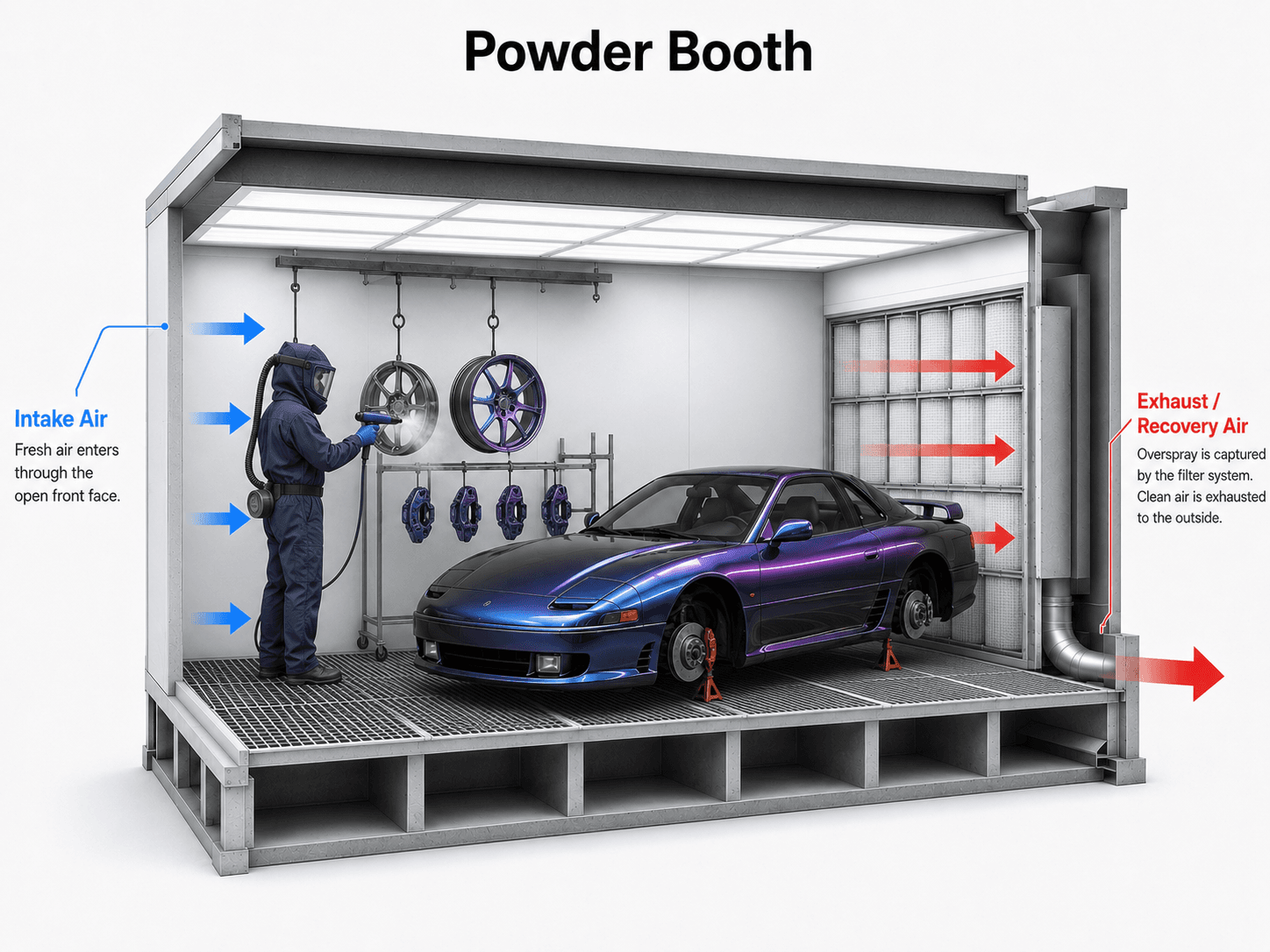
Where a batch booth serves a shop, an in-line recovery booth serves a production schedule. The RM family exists for operations where parts arrive on a conveyor all shift and the powder bill is big enough that reclaiming overspray pays for the recovery hardware. Instead of disposable media eating the whole overspray load, cartridges do the capture work for months at a time, cleaned in place by pulses of compressed air, while a final filter stage backstops whatever gets past them. Your recurring purchases become cartridge sets on a long cycle and final filters on a longer one.
Quick answer
Rohner's In-line Process Recovery Powder Booth is a conveyorized production booth with cartridge powder reclaim: parts pass through on a line while recovery cartridges capture overspray for sieving and reuse instead of sending it to disposal. The RM family runs from the RM4000 to the RM12000, covering roughly 4,000 to 12,000 CFM with working chambers from 5 to 7 feet wide, 6 to 10 feet high, and 20 to 24 feet deep. Consumables split in two: reclaim cartridges that clean in place, and downstream final filters that protect the fan and the discharge air. Fitment for this family is catalog-documented, so confirm cartridge and final-filter specs with a quote before stocking up.
How In-line Process Recovery Powder Booth shops choose filters
Recovery cartridges. The cartridges are the working heart of the booth: they capture oversprayed powder at the extraction plenum so it can be sieved back into the feed. Pulse cleaning knocks accumulated powder off the cartridge media repeatedly, but every cartridge has a finite life. The tell is pressure that no longer recovers after a pulse cycle. At that point the media is blinded and replacement is the fix. On a color-dedicated line, cartridge sets also get swapped when the line changes its base color family, since embedded pigment cross-contaminates reclaim.
Final stage. Behind the cartridges sits final filtration, the stage that keeps fine powder out of the fan and out of the air the booth discharges. It loads slowly when the cartridges are healthy and quickly when they are not. Treat a sudden final-stage pressure rise as a cartridge inspection trigger, not just a filter change.
Cycle math. Cartridge count and final-filter area scale with the RM size, so two shops running the same booth name can carry different consumable sets. Log pulse-cycle pressure recovery weekly; the trend line tells you cartridge replacement timing months in advance, which matters when a set is a planned line-stop.
Regulatory landscape
Powder lines mostly sit outside EPA's NESHAP 6H, which is aimed at spray-applied liquid coatings containing target metal HAPs. The obligations that do bite are OSHA 29 CFR 1910.94(c) on ventilation for spray finishing, which expects maintained extraction and no contaminated air returned to the work area, and NFPA 33 on the fire-safety side, where finely divided powder is combustible dust. A recovery booth concentrates that dust by design: in cartridges, in the reclaim path, and in any final media. Keep pulse systems working, follow the manufacturer's cleanout intervals, and treat spent cartridges and loaded final filters as fuel packages when storing and disposing of them.
Who runs the In-line Process Recovery Powder Booth
The RM family lives in production environments. Product manufacturers coating a steady stream of their own parts, where the conveyor never really stops and reclaim yield is a tracked KPI. Contract powder coaters running dedicated lines for anchor customers, where a cartridge failure mid-run is a delivery problem, not an inconvenience. And automotive or appliance component suppliers feeding assembly schedules, where the booth's extraction health is audited alongside everything else on the line.
In-line Process Recovery Powder Booth filter FAQs
How do I know when recovery cartridges are actually done?
Watch what pulse cleaning gives back. Healthy cartridges return to a consistent baseline pressure after each pulse cycle; end-of-life cartridges show a baseline that ratchets upward week over week because powder has embedded in the media where pulses cannot release it. When the baseline will not come down, replace the set.
Do I replace cartridges individually or as a set?
As a set, in almost every case. Mixing new and blinded cartridges skews airflow toward the new ones, overloading them early and leaving dead extraction zones near the old ones. The exception is a single physically damaged cartridge in an otherwise young set, which you can replace alone.
What final filters does the RM series take, and can you supply them?
Yes, alongside the cartridges. Final-stage specs vary across the RM4000 to RM12000 range because filter area scales with the booth's airflow, and our record for this family comes from Rohner's catalog documentation, so we confirm your exact RM designation on the first order and lock both stages onto a repeat schedule from there.
Does reclaimed powder quality depend on the filters?
Directly. Reclaim quality depends on cartridges releasing captured powder cleanly and on the reclaim path staying uncontaminated. Blinded cartridges hold powder back from the sieve; a compromised final stage lets fines escape the recovery loop. If reclaim ratio drops, audit the filtration before blaming the guns.
Is this booth covered by EPA 6H like a liquid spray booth?
Typically not. 6H targets spray-applied liquid coatings containing specific metal HAPs, and powder application generally falls outside that scope. Your operating obligations center on OSHA 1910.94(c) ventilation performance and NFPA 33 combustible-dust practice.
Sources
Primary references cited on this page.
- Rohner In-line Process Recovery Powder Booth manufacturer product pagehttps://www.rohnerspraybooths.com/powder-coating-booths/inline-process-recovery-booth/
- OSHA 29 CFR 1910.94(c), Ventilation: spray finishing operationshttps://www.osha.gov/laws-regs/regulations/standardnumber/1910/1910.94
- NFPA 33, Standard for Spray Application Using Flammable or Combustible Materialshttps://www.nfpa.org/codes-and-standards/nfpa-33-standard-development/33
Related on BoothFilterPro
- All Rohner models
Brand hub
- Rohner Side Downdraft
Sibling Rohner model
- Rohner Open Front Booth
Sibling Rohner model
- Rohner Custom Crossdraft
Sibling Rohner model
- Rohner Custom Downdraft
Sibling Rohner model
- Paint Mixing Room
Sibling Rohner model