
Marathon Finishing · Prep station
Marathon Finishing Prep Pro 4000D
Filter kit, alternatives, and current pricing for the Prep Pro 4000D.
Fitment data is being verified. Our team is still cross-referencing manufacturer specs for the Prep Pro 4000D. Confirm filter sizes with WERCS before ordering: request a fitment confirmation.
Marathon Finishing model • Prep Pro 4000D
Marathon Prep Pro 4000D Filter Program
Sanding dust and primer overspray load media faster than topcoat ever will. A filter cadence built for what the Prep Pro 4000D actually does all day.
Every hour a car spends being sanded inside a spray booth is an hour that booth is not painting, which is the business case for a dedicated prep station and the niche Marathon Finishing builds the Prep Pro 4000D to fill. Marathon sells booths and prep equipment into the North American collision market, and the 4000D is its prep-line entry in our catalog. The filtration story is unglamorous and relentless: primer is heavy in solids, sanding throws dust continuously, and prep media lives a short, hard life. Shops budget filters for the spray booth and are routinely surprised that the prep deck out-consumes it.
Quick answer
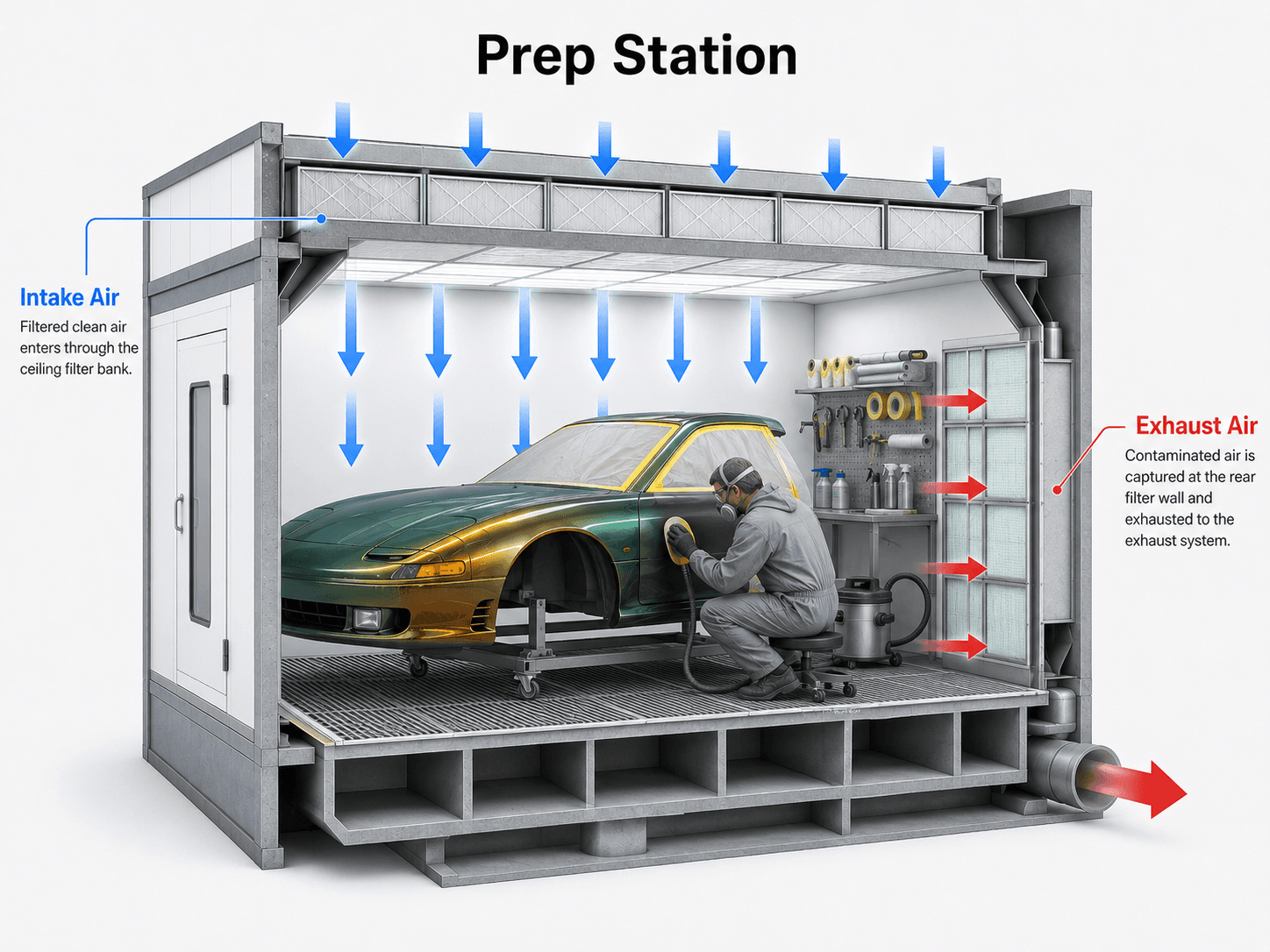
The Marathon Finishing Prep Pro 4000D is a prep station: a ventilated work zone where vehicles are sanded, masked, and primed before they reach the spray booth. Its filtration handles a harsher diet than a finish booth's, mostly sanding dust and primer overspray, which load media quickly. The working program is intake or diffusion media where supply air enters the work zone and arrestor media at the capture point, changed on a shorter cycle than booth filters. The 4000D is catalog-documented and pending field verification with us, so media dimensions are confirmed by fitment check or quote before a bulk order ships.
How Prep Pro 4000D shops choose filters
What loads the media. Primer-surfacer overspray is high-solids by design and blinds arrestor faster than basecoat. Add dry-sanding dust that any vacuum system only partially captures, and prep station media routinely reaches change condition well before an equivalent pad in a topcoat booth would. Plan cycles around that reality rather than around booth habits.
Supply and capture stages. Supply-side media keeps the work zone air clean enough that fresh primer does not seed itself with dust, and capture-side arrestor keeps particulate out of the exhaust path and the shop. Because the dossier for the 4000D documents the model without recorded dimensions or a verified slot layout, we do not publish panel counts or sizes for it; prep stations also vary by installation (full enclosure versus curtained open front) in ways that change the media list. The fitment check settles your configuration with a nameplate photo and a few measurements, once.
Cycle math. A practical rule for prep environments: whatever interval you would run in a finish booth, expect the prep station to demand changes noticeably sooner, tuned by primer volume and how much sanding runs dry versus wet. High-holding polyester arrestor typically earns its price in this duty by extending intervals a fiberglass pad cannot hold in dust-heavy service.
Regulatory landscape
Prep work sits squarely inside the rules shops sometimes assume are booth-only. EPA 6H (NESHAP Subpart HHHHHH) explicitly covers spray-applied coatings including primers, so priming in the 4000D belongs inside a filtered, ventilated enclosure with the same recordkeeping as the booth. OSHA 1910.94(c) applies to spray finishing operations wherever they happen, and OSHA also cares about the sanding-dust exposure the station's ventilation controls. NFPA 33 rounds it out: primer overspray accumulated in arrestor media is combustible loading. Dated change records for the prep deck carry the same audit weight as booth records, and are more often missing.
Who runs the Prep Pro 4000D
Prep Pro 4000D owners are throughput thinkers. Collision centers that moved sanding and priming out of the booth to raise paint-line capacity, where the prep station now runs more hours than the booth it feeds. MSO production facilities standardizing a prep-deck-plus-booth lane in every store, which want one filter vendor tracking sizes across all of it. And busy independents that added the 4000D as their first piece of dedicated prep ventilation, usually after a shop-air dust problem or an OSHA conversation made the open-floor sanding bay untenable.
Prep Pro 4000D filter FAQs
What filters does the Prep Pro 4000D take?
Supply-side intake or diffusion media and capture-side arrestor media, consistent with its prep-station role. Exact dimensions, panel counts, and configuration for this model are pending field verification in our catalog, so we confirm your installation through a fitment check before shipping bulk quantities.
Why does my prep station go through filters faster than my spray booth?
Because its diet is worse. High-solids primer overspray plus continuous sanding dust load media much faster than topcoat mist does. That is normal for the duty, and the fix is a shorter cadence and higher-holding media, not stretching booth intervals onto prep equipment.
Do I really need to run primer inside the prep station?
Yes, on both compliance and quality grounds. EPA 6H treats spray-applied primer like any other coating, requiring filtered, ventilated enclosure and records. Practically, priming in open shop air also feeds dust back into your paint pipeline and undoes the point of having a prep deck.
Can you quote media without knowing my exact configuration?
We can quote by media type immediately and finalize sizes through the fitment check: nameplate, a photo of the supply plenum or curtain layout, and one measured pad or panel per stage. After that single exchange, your 4000D record is locked and reorders are automatic.
Is fiberglass or polyester arrestor better for prep duty?
In dust-and-primer service, polyester usually wins on holding capacity, meaning fewer changes before pressure drop climbs, while fiberglass wins on unit price. High-volume prep decks tend to come out ahead on polyester once labor and downtime per change are counted. Your primer volume decides it, which is part of the quote conversation.
Sources
Primary references cited on this page.
- Marathon Finishing Prep Pro 4000D manufacturer product pagehttps://marathonspraybooths.com/products/
- OSHA 29 CFR 1910.94(c), Ventilation: spray finishing operationshttps://www.osha.gov/laws-regs/regulations/standardnumber/1910/1910.94
- EPA 40 CFR Part 63 Subpart HHHHHH (NESHAP 6H)https://www.epa.gov/stationary-sources-air-pollution/national-emissions-standards-paint-stripping-and-miscellaneous
Related on BoothFilterPro
- All Marathon Finishing models
Brand hub
- Full Downdraft
Sibling Marathon Finishing model
- SPB-52D
Sibling Marathon Finishing model
- SPB-76FD
Sibling Marathon Finishing model