Col-Met · Semi-downdraft
Col-Met Semi-Down Draft (8550-NP)
Filter kit, alternatives, and current pricing for the Semi-Down Draft (8550-NP).
Fitment data is being verified. Our team is still cross-referencing manufacturer specs for the Semi-Down Draft (8550-NP). Confirm filter sizes with WERCS before ordering: request a fitment confirmation.
Col-Met model • Semi-Down Draft (8550-NP)
Col-Met Semi-Down Draft 8550-NP: Filters Are the Control System
On a workhorse semi-downdraft, the gauge on the wall reads your filters. Here is the media program that keeps the 8550-NP in its lane.
Strip away the electronics and every spray booth is controlled by one thing: the resistance the air has to fight through. On a working 8550-NP, the instrument that tells you the truth is the draft gauge or manometer across the filters. Fresh media, the booth pulls its design air; loading media, the diagonal flow slows and overspray starts hanging in the rear third of the cabin. Shops that treat the gauge reading as the control input, and the filter change as the control action, get years of consistent work out of these booths. That discipline, not any panel of buttons, is the real control system.
Quick answer
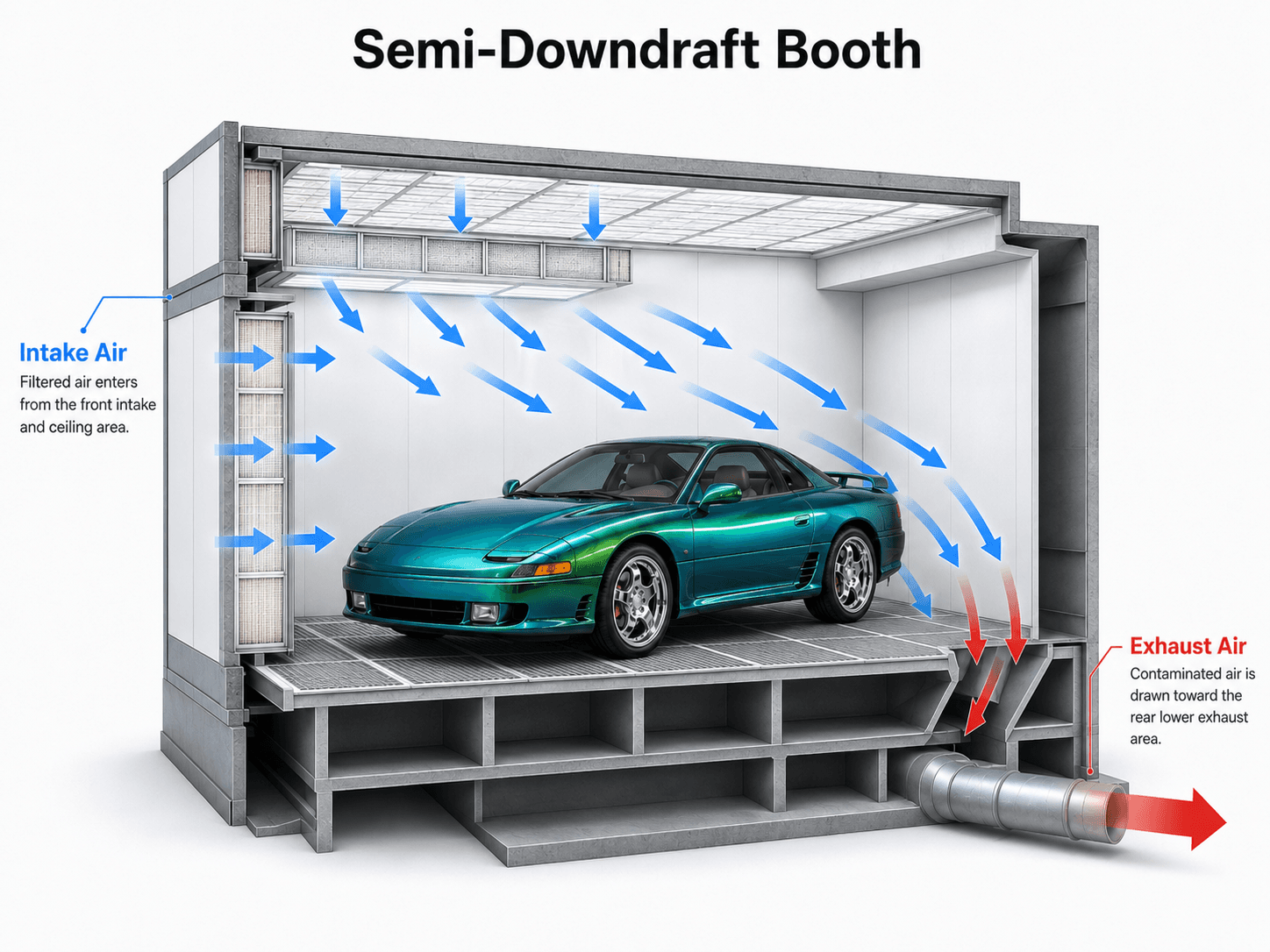
The Col-Met Semi-Down Draft 8550-NP is one of Col-Met's numbered 8500-series workhorse booths. As a semi-downdraft, it draws air in through intake filters in a forward section of the ceiling and pulls it diagonally through the cabin to an exhaust filter bank at the rear, combining downdraft-like air over the vehicle with crossdraft-simple construction. Its filter program runs intake ceiling media and rear exhaust arrestor media, plus an AMU pre-filter on heated installations. Our fitment record for the 8550-NP is catalog-sourced and pending field verification, so sizes are confirmed against your booth before a kit ships.
How Semi-Down Draft (8550-NP) shops choose filters
Intake side. Intake media sits in the ceiling section toward the front of the cabin, where make-up air enters before sweeping back and down. Diffusion-grade media here keeps incoming air clean and evens the flow so the diagonal path develops properly instead of jetting. The intake bank covers only part of the ceiling, so this is an inexpensive position to keep fresh.
Exhaust side. The rear filter bank carries the arrestor media that catches overspray, and in a semi-downdraft it works hard: the diagonal path delivers overspray to the rear wall at working height, concentrated. Fiberglass arrestor pad or roll stock is the standard fill. The 8550-NP record in our catalog is not yet field-verified, so we confirm frame dimensions and opening count from your measurements or photos before locking a kit; 8500-series booths were built in enough configurations that assuming is how wrong media gets shipped.
Cycle math. Expect the rear bank to set the change rhythm and the intake ceiling section to run several cycles longer. Watch the manometer trend, not the calendar date: rising static across the exhaust is the change signal.
Regulatory landscape
OSHA 1910.94(c) requires spray-finishing ventilation to maintain design velocity while spraying, and on a semi-downdraft the exhaust bank's condition is that velocity's limiting factor, so the manometer discipline described above is also the OSHA discipline. NESHAP 6H requires exhaust filtration on target-coating operations, maintained per manufacturer recommendations, with records; the 6H maintenance log and your filter change log should be the same document. NFPA 33 governs overspray accumulation and combustible loading, which for a rear-bank booth means changing arrestor media before it saturates and keeping the removed media handled as the loaded waste it is.
Who runs the Semi-Down Draft (8550-NP)
The 8550-NP population skews toward shops that run a booth as a production tool rather than a showpiece. Fleet and light-truck refinishers who chose semi-downdraft because it handles longer vehicles gracefully without a pit. General collision shops in markets where the booth runs every day and the buying criteria were durability and part availability. And industrial coaters spraying steady batch work who like that a semi-downdraft holds a single, predictable air path.
Semi-Down Draft (8550-NP) filter FAQs
What does the manometer reading actually tell me on this booth?
It reads differential pressure across the filter bank, which is a direct measure of how loaded the media is. Record the reading with fresh filters installed; as media loads, the reading climbs, and the manufacturer guidance for your media sets the change threshold. On a working 8550-NP that gauge is the closest thing the booth has to telemetry, so keep it plumbed and legible.
Where are the filters on a Semi-Down Draft 8550-NP?
Intake media is in the forward ceiling section where air enters the cabin, and exhaust arrestor media is in the filter bank at the rear of the booth ahead of the fan. Heated installations add an AMU pre-filter stage at the make-up air unit. There is no pit and no side plenums on this layout.
Can you ship me filters from just the model number 8550-NP?
Not responsibly. This model's fitment record is catalog-sourced and flagged for verification, and 8500-series booths vary by configuration. Measure one exhaust frame opening, count the openings, note the intake panel layout, and we confirm the kit; the fitment then gets verified by the WERCS service team so repeat orders are automatic.
Why does the back of my booth get dirty faster than the front?
That is the semi-downdraft geometry working as designed: air and overspray travel front-to-back and down, so the rear bank and rear cabin surfaces take the concentration. It becomes a problem only when loading is allowed to slow the airflow, at which point overspray starts settling mid-cabin on wet paint. Change the rear media on gauge, and wipe down the rear third more often than the front.
Is the 8550-NP a good candidate for a filter subscription?
It is close to the ideal case. Workhorse booths in daily production load media at a steady, predictable rate, which is exactly what a standing program is built on. After the first cycle or two establishes your gauge behavior, deliveries land just before the change threshold.
Sources
Primary references cited on this page.
- Col-Met Semi-Down Draft (8550-NP) manufacturer product pagehttps://colmetsb.com/
- OSHA 29 CFR 1910.94(c), Ventilation: spray finishing operationshttps://www.osha.gov/laws-regs/regulations/standardnumber/1910/1910.94
- EPA 40 CFR Part 63 Subpart HHHHHH (NESHAP 6H)https://www.epa.gov/stationary-sources-air-pollution/national-emissions-standards-paint-stripping-and-miscellaneous
Related on BoothFilterPro
- All Col-Met models
Brand hub
- Standard Downdraft
Sibling Col-Met model
- Value Crossdraft 8191
Sibling Col-Met model
- Standard Crossdraft
Sibling Col-Met model
- Open Face Paint Booth
Sibling Col-Met model
- Standard Semi-Downdraft
Sibling Col-Met model